Soccer Ball Design

In this section of Soccer Ball World, the construction and soccer ball design is described. This includes the various materials used, types, sizes and weights of soccer balls. The following topics are reviewed:
- Construction of the Ball – The various parts of the soccer ball are explained. Typical materials used on the different parts of a soccer ball and how they are put together are also detailed.
- Types – The different types of soccer balls are detailed. Use this section to also learn about the typical materials that are used on the different types of soccer balls. This will help you determine what soccer ball is best for your application and skill level.
- Sizes and Weights – The various sizes of the soccer ball are shown and explained. Different age groups use different ball sizes and weights. Determine what size of ball is right for your game or buying needs.
Find out about the latest soccer ball designs and top balls from various brand names in the Developments section.
Ball Construction
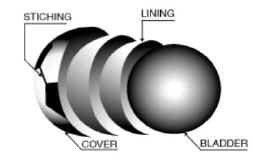
The four main components of a soccer ball are the cover, the stitching, the lining and the bladder. Understanding these components and their options will help you in choosing the perfect ball to meet your playing and quality needs.
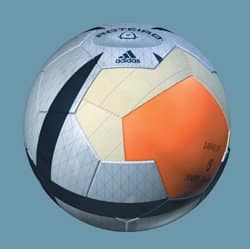
For information on how the ball is put together, click here. Elements of Soccer Balls and Materials used in Production
- Surface, Casing or Cover
- Stitching
- Internal Linings (Polyester or Cotton)
- Bladder (Latex or Butyl)
Covers
The surface of soccer balls or coverings are made up from synthetic leather and not full grain leather (as used in the past) because leather has a tendency to absorb water causing the ball to become very heavy. Synthetic leather is typically made from PU (polyurethane)
and PVC (poly vinyl chloride).
There are many variations of synthetic leather used in the construction of soccer balls. They range from AI-2000, Japanese Teijin Cordley, Microfiber, English Porvair, Korean Ducksung, Leather Art Pakistan Synthetic Leather, and PVC (poly vinyl chloride). Best soccer balls used in competition and by professionals are produced by using AI-2000, Cordley, Ducksung, Mircofiber or other types of PU synthetic leather. Promotional soccer balls or practice balls are usually constructed with Polyvinyl Chloride(PVC) or rubber (molded or stitched) covers.
Some indoor soccer ball covers are made with a felt material similar to what is used on a tennis ball.
Panels
- The number of panels — the different segments that make up the outside covering of the ball — varies for each design.
- A 32-panel ball is the most common and is the type used in most professional matches. The soccer ball is essentially a Buckminster Ball consisting of 20 hexagonal (six sided) and 12 pentagonal (five sided) surfaces. Also known as a truncated icosahedron except that it is more spherical, because the panels bulge due to the pressure of the air inside.
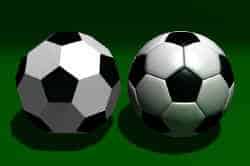
When they are sewn together and inflated they make a near perfect sphere. For more information on the Buckminster ball and the history of the soccer ball, click here.
- Other traditional designs are 18 and 26-panel constructions, used in various professional leagues, including Major League Soccer (until 2002), Scottish and English leagues.
- Fewer panels generally means the ball can be curved more when kicked because of less stability to the cover. For more information on how a soccer ball curves when kicked, click Here
Panels can be either stitched, glued or thermally molded together:
- Stitched
- The highest quality balls are stitched with a polyester or similar thread. 5-ply twisted polyester cord is the material of choice in stitching together a soccer ball. Hand sewn balls have tighter and stronger seams. Kevlar® reinforced polyester stitching is also used on some balls.
- High-end balls are hand-stitched, while most mid-priced balls are machine-stitched.
- Glued
- Lower-end, practice balls generally have the panels glued together onto the lining.
- These offer a harder feel and are generally less expensive than stitched balls.
- Thermally Molded – The new World Cup 2010 Jabulani Ball and the Roteiro ball have panels that are thermally molded together.
The last stitch
Many enquiries have been made about how the last stitch is made. Check out the following video:
Linings
Material thickness plays a vital part in the quality of hand-sewn soccer balls. Multiple layers of lining are placed between the cover and the bladder. These layers are composed of polyester and/or cotton bonded (laminated) together to give the ball strength, structure and bounce. Professional soccer balls usually have four or more layers of lining. Promotional or practice balls are often constructed with less layers of lining. The lining helps the ball retain it’s shape and bounce over the life of the ball.
Many soccer balls include a foam layer for added cushioning and ball control.
Bladders
The bladder in a soccer ball holds the air. Bladders are usually made from latex or butyl. Compared to latex bladders, butyl bladders retain air for longer periods of time. Latex bladders tend to provide better surface tension. However; butyl bladders offer the excellent combination of contact quality and air retention. Futsal ball bladders are filled with foam to limit the bouncing capability of the ball since they are used on a hard flooring.
Most balls use butyl valves for air retention, with higher end balls using a silicone-treated valve for superior performance. Silicone treated valves are used on some balls for smooth insertion of the inflating needle and added protection from air loss. When you first receive a ball, a good idea is to put a few drops of silicon oil in the valve. This will provide easier needle insertion and better air retention.
Natural Latex Rubber bladders offer the softest feel and response, but do not provide the best air retention. Micro pores slowly let air escape. Balls with natural rubber bladders need to be re-inflated (at least once a week) more often than balls with butyl bladders (stay properly inflated for weeks at a time). Some balls use carbon-latex bladders in which the carbon powder helps to close many of the micro pores. Latex bladders are used in balls because of the following characteristics:
A- It gives proper bounce.
B- It feels softer.
C- Same angle re-bounce characteristics.
Butyl bladders offer an excellent combination of feel and air retention and can be found in most middle to upper priced balls.
PU – Some manufacturers use bladders made from polyurethane.
How Most Hand Stitched Soccer Ball Parts are Put Together
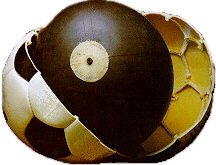
The first stage is to roll out the material to be used for the outing casing of the ball. The casing is usually made from several layers of synthetic foam-filled leaves (panels), which are glued (laminated) together to produce a tough, smooth exterior.
The leaves are cut into the exact amount needed to make one ball. Then the panels are pre-printed with any brand names and graphics before being cut. All logos would be printed at this point in the process. Printing is typically accomplished by silk-screening onto the cover material. After printing, the material may have another layer of clear urethane (or another proprietary material) applied over the printing for protection.
The number of individual panels required are then cut out, and holes are pre-punched in preparation for stitching. The stitching is performed by turning the ball inside out, so none of the stitches show on the outside. A different type of needle is used to complete the stitching of each panel, which effectively makes the final knot ‘disappear’.
The stitched ball is then reversed, the bladder inserted and inflated. One stitcher can usually do four balls in one day.
Check out the soccer ball design for the 2010 Official World Cup Jabulani ball.
Then another process begins for those soccer balls seeking either NFHS Authentication, FIFA Approved, FIFA Inspected or International Matchball Standard (IMS) status. That process is the independent laboratory testing required to achieve one of these hallmarks. For a more detailed look at the approval types and testing procedures, click here.