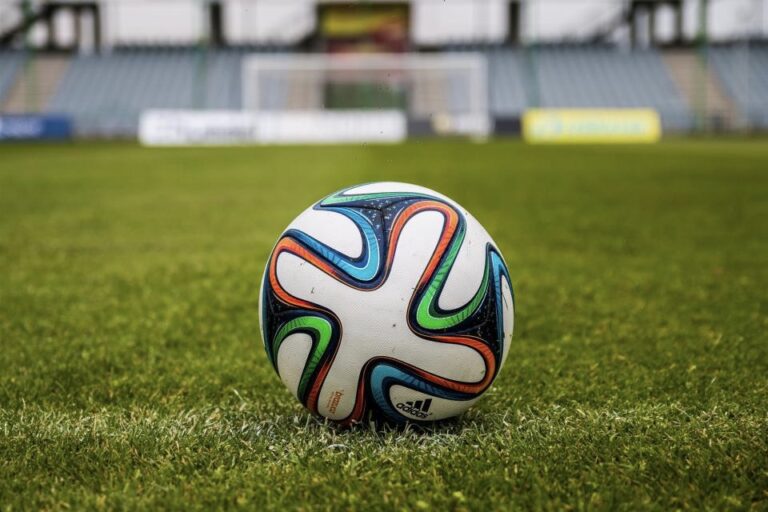
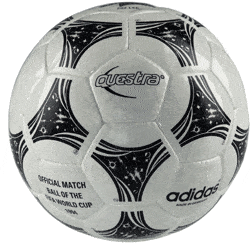
Official 1994 World Cup Ball Adidas Questra
Articles and pictures from Sheridan Bird, January 28, 2004
In June 1990, the football viewing public were eagerly anticipating the start of the sport’s greatest tournament, the FIFA World Cup, in Italy, a country widely known and loved for its creativity and artistic ambience. A leader in fashion, wine, art and sculpture, the host nation seemed ready to provide the perfect backdrop for a festival of exciting, flowing football.
However, the reality was far from the fantastic feast all had hoped for. Despite some tremendous waves of emotion, notably from host nation Italy in their painful semi-final exit, and likewise England, goals were at a premium. This was the first world cup which saw teams belligerently playing for penalties, without trying to attack or impose themselves in the 90 minutes and extra time. This was for many, a sterile, cynical World Cup.
The dreary deadlock of many of the knockout matches caused a headache for FIFA, who were desperate for the next World Cup, to be held in the USA, to be a triumph. Americans were more accustomed to high scoring sports, and tepid, defensive 0-0 results would send the TV viewers away in their droves, thus jeopardizing vast amounts of advertising revenue. FIFA needed a way to make football exciting and unpredictable again. Crackpot schemes like making the goals bigger were proposed, and then rightly binned, but FIFA had a brainwave. They asked the official matchball manufacturer, Adidas, to jazz up the ball.
THE QUEST FOR THE STARS
FIFA WORLD CUP 1994
Adidas concluded that the key to more goals was a lighter, more responsive ball, which would be the perfect tool for a gifted player. Out went heavy, slow balls, and in came the Questra. Taking its name from an ancient word meaning “the quest for the stars”, the new ball took its logo from its space age technology, and as a tribute to the host nation’s rich history of space exploration. The whole concept was based on the themes of innovation and striving for perfection.
The technical development for the Questra took place in the Adidas center for ball development in France, followed by test games in France, Germany and the USA with professional players, amateurs and youth teams. The ball was manufactured from five different materials with a flexible but durable outer layer made from polyurethane. Each trigon featured an array of space imagery: planets, black holes and, of course, stars.
Within a week of the tournament, some spectacular goals had been scored. As predicted, the better players took to the lighter model with no difficulty. Memorably, Romanian captain Hagi floated a wonderful goal over the stricken goalkeeper’s head from distance in an early group match.
However, the goalkeeping fraternity found the ball too hot to handle. In some of the venues, such as Florida and California, the regional humidity caused the ball to bend and move in the air like never before. This made life extremely tough for the men in gloves. But, as FIFA had requested, the goals flew in from some impossible angles, and the competition was a resounding success. In terms of sheer, attacking play and flair, USA ’94 was a sensation. Of course, the final was a drab 0-0 affair, but not even space age technology could be expected to change the mentality of a defensive footballing nation such as Italy. Adidas was responsible for the balls, not tactics.
OLYMPICS 1996
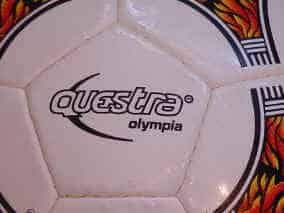
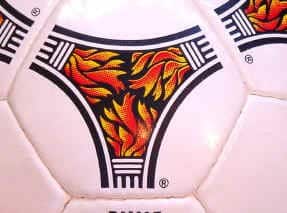
The triumph of the Questra led to the birth of several new models. For the Olympic football tournament in Atlanta, the ball was given a new image and named the Questra Olympia. The fabled Olympic flame was placed in the trigon as a tribute to the spirit and history of the games.
EUROPEAN CHAMPIONSHIPS 1996
The England badge was used for the Questra Europa ball at Euro ’96, as an embodiment of the host nation’s heritage. The infamous three lions and red roses replaced the stars and planets. Other than the new logos the balls themselves were the same as their predecessor in 1994.
For additional information on the Europa ball and other European Championship balls, click here.
SPANISH LEAGUE AND NATIONAL TEAM
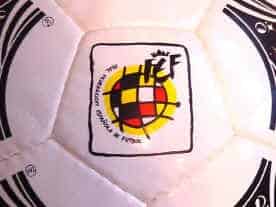
The last high profile incarnation of the Questra was in the 1996-97 season in Spain. A special edition with the Spanish football association’s eye-catching Miró-esque logo was produced, and used in league matches and by the national team. This was the Questra Apollo.